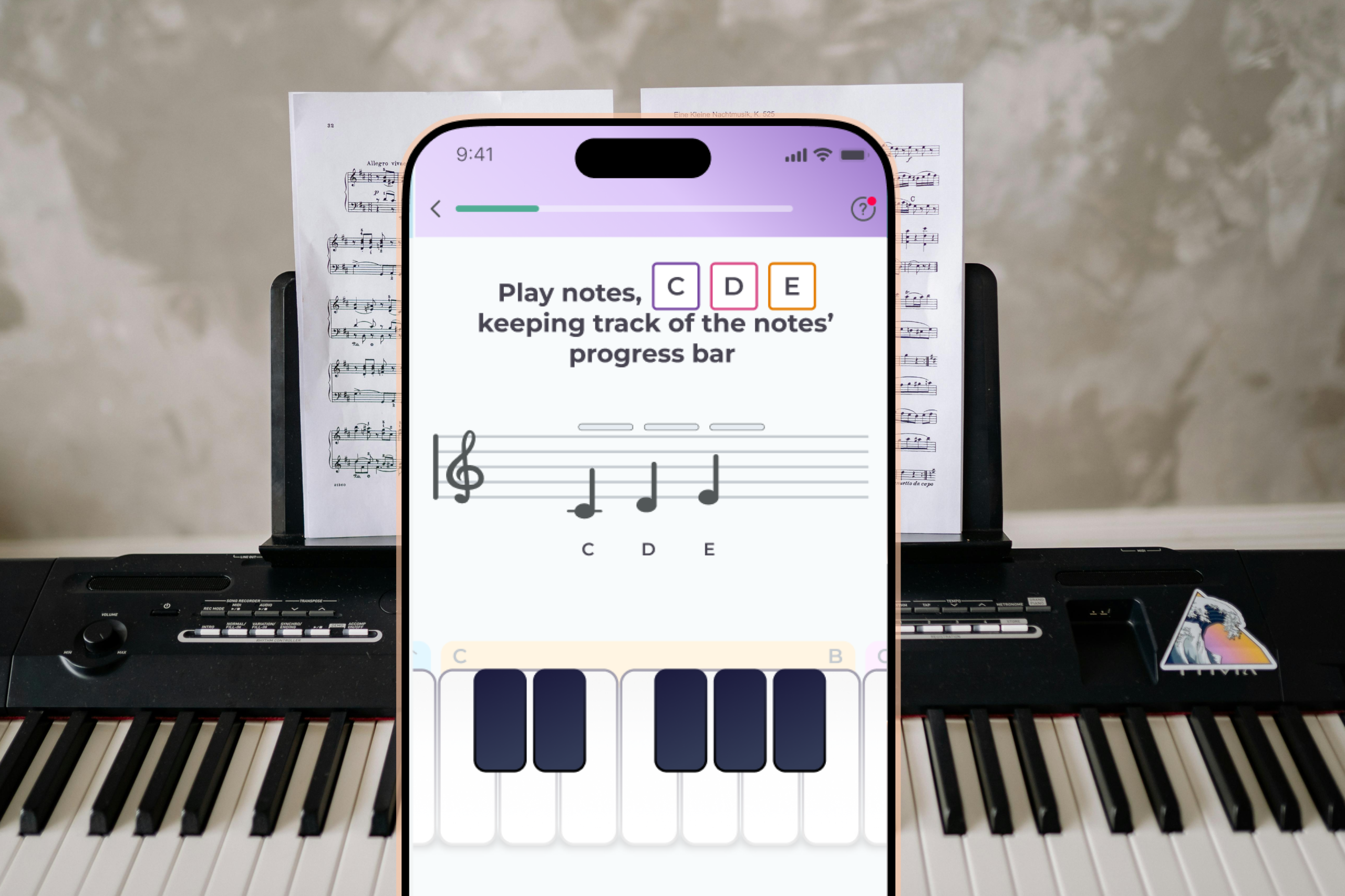
In music, every moment counts. Imagine learning a new melody, and right there and then you hear where and how improvements can be made—revolutionary, rather than just convenient. This is all part of the learning in our app—instant feedback. Now, why is this so important? Here are a few key reasons: real-time feedback; audio analysis; pitch detection; timing. In practical terms, audio capture and signal processing form the backbone of this approach, offering a technical overview that turns sonic insights into practice enhancement. Even a free piano learning app can benefit from a clear feature explanation of how real-time processing and waveform analysis guide better play.
- Material Assimilation speed. More effective skill development the faster the student receives information about errors and achievements.
- Motivation to learn: clear goals, negative mistakes turn into, and moving forward success becomes a reason for.
- Avoiding wrong patterns: If not attended immediately, there’s a chance of embedding wrong movement and auditory perceptions.
- Immersion into the process: The concentration is maintained, and it fosters self-improvement through feedback.
A simple but powerful idea follows from this, namely: delay in responses slows learning and reduces engagement. Our solution targets these issues exactly.
Technological Foundation How Instant Response Is Achieved
Instant feedback relies on a number of building blocks of technology integrated together. This real-time feedback pipeline is an algorithm pipeline that connects app internals with visualization tools to keep the loop tight.
| Component | Description |
| Real-time audio analysis | Due to it, the in-engine sound engine is continuously breaking down the signal into notes and rhythm. |
| Neural network algorithms | Processing of audio streams, comparing performance to standards, identification of deviations and errors. |
| Optimized latency | Methods minimizing latency are employed to provide results as quickly as possible. |
| UI/UX integration | Outcomes of the analysis can be viewed in real time, suggestions are given within an interface, with musical suggestions. |
It can be described as:
- Performance is initiated by the user.
- It picks up the sound via the microphone while sending this data to the audio analysis engine.
- The neural network instantly finds a match for the played notes with the reference notes.
- Computed data is sent for display: a report appears in one second ready for absorption.
Repeatedly, this dynamic cycle thus allows the continuous connection between performer and app without noticeable delays. One second has passed—and you understand what went wrong before you forget how you just played. In this way, this approach quickens learning and makes its very nature interactive, vivid, and responsive, as it happens in any real ensemble game when everybody listens and promptly responds. A technical overview here includes timing analytics, pitch tracking, acoustic modeling, and app internals that translate waveform analysis into clear guidance.
The Psychology of Receiving Feedback What Happens in the User’s Mind
It is not just a collection of words or information; feedback interfaces with the cognitive and emotional processes flowing within the user’s consciousness.
The instantaneous response by Talented was the key to triggering a chain of neuropsychological mechanisms that deeper assimilation of information and motivation enhancement could facilitate.
Key aspects of this perception—let us consider.
- Attention Enhancement: A timely response captures the focus, thus helping to exclude distracting factors and switch attention to the task.
- Memory Activation: Instant feedback creates a context, through which new knowledge connects with pre-existing neural networks.
- Emotional Reinforcement: Positive or corrective comments instantly influence mood, reduce anxiety while strengthening self-confidence.
- Self-Regulation: User gets to review actions immediately and start adjusting them toward improvement with no unnecessary delay.
It therefore follows that immediate feedback from Talented works not only as an informant but also as a spur for self-analytical and developmental processes from within. Because of this, real-time feedback can greatly heighten productivity and the quality of learning. Fine-grained timing in the loop supports feedback science by aligning perception with action.
Advantages and Possible Limitations of the Instant Feedback System
The work that we have done in developing the instant feedback system is based on the concept of maximum efficiency and the convenience of users. This approach not only ensures that users get an immediate response but also:
But most importantly, information that lets them grow and practically changes their actions “on the fly.”
But, just like any other technology, the strong points that the system possesses *
Along with several limitations that have to be considered.
Primary benefits
- Immediacy of response.
The rapid feedback most obvious and important contributes toward holding attention and forming stable habits. Actions are becoming connected to results directly in the brain when feedback arrives in seconds, which helps retain the material better. - Personalization.
Feedback adapts the characteristics of each specific user. Algorithms take into account learning style, progress, and even emotional state. It thereby increases the effectiveness of interaction. - Enhancement of motivation.
Instant recommendations let the users see improvement and realize their efforts are not going unnoticed. Interest is maintained this way, and further development is stimulated. - Decreasing of the cognitive load.
Chunking information into small units and providing support at opportune times reduces stress and prevents weary exhaustion.
Possible limitations
- Too much reliance on feedback. There is a risk that too frequent prompts could reduce the ability for autonomous decision-making and thinking.
- Contextual limitations. Often based on current data, instant feedback may fail to reflect a broader situational context or the user’s long-term goals.
- Technical barriers. Smooth operational experience with minimal delays requires a stable internet connection and powerful devices.
- Possible perception glitches. Quick feedback might be associated with excessive criticism or pressure, requiring fine-tuning of communication with the user.
In a nutshell, potential benefits of the system outnumber its risks, especially when careful developers and specialists are working on them. Therefore, continuous development of algorithms, the use of new models for adaptation, and learning to really listen to each user ensure that the learning journey becomes as comfortable and productive as possible. The technical overview continues to evolve with audio analysis improvements, timing analytics, and Talented tech refinements.
The Future of Feedback at Talented Innovations and Development Directions
It is important to look not at the current achievements but rather at the horizons opening for the system in the coming years, when the topic is the promising development of instant feedback at Talented.
No standing still do technologies, and with them is even transformed the very concept of interaction of a user and a platform.
Conditionally divided into three key blocks, the main directions of development that already today set the vector of future innovations are as follows:
1. Deep Personalization
- Automatic adjustment in style and form of feedback according to the individual preference and emotional state of the user.
- Employ advanced behavioral data analytics to predict needs and optimal timing of information delivery.
- Integration with biometric sensors that estimate levels of stress or concentration will enable more sensitive and relevant feedback.
2. Development of Artificial Intelligence Capabilities
For the recognition of more complex contexts and subtleties in users’ queries, the cognitive capabilities of AI are empowered. Reinforcement learning models improve the quality of feedback continuously based on real results and feedback.
- To enable brighter and more effective interaction, multichannel communications that combine text, voice, and visualization shall be created.
3. Integration with Development and Education Ecosystems
- Talented is integrated with external learning management systems and corporate platforms; a unified space is created in which immediate feedback will become part of the skill development and progress assessment chain.
- The joint analysis and combination of feedback from multiple participants support collective learning formats.
At Talented, feedback will be not just a tool of assessment but a full partner in learning—always at hand, flexible, smart helper capable of inspiring not just correcting. It is also a challenge for developers and researchers who look into the future: ethics, transparency, and confidentiality issues will have to be taken into consideration so that new tools remain safe and trustworthy for each user. Undoubtedly, it is just the mixture of innovation and humanity that in the next stage will make instant feedback at Talented unique and maximally effective for those who strive for continuous growth and improvement. In that direction, audio analysis and real-time feedback will deepen with better pitch tracking, timing analytics, and richer visualization tools—an app internals evolution powered by Talented tech.